

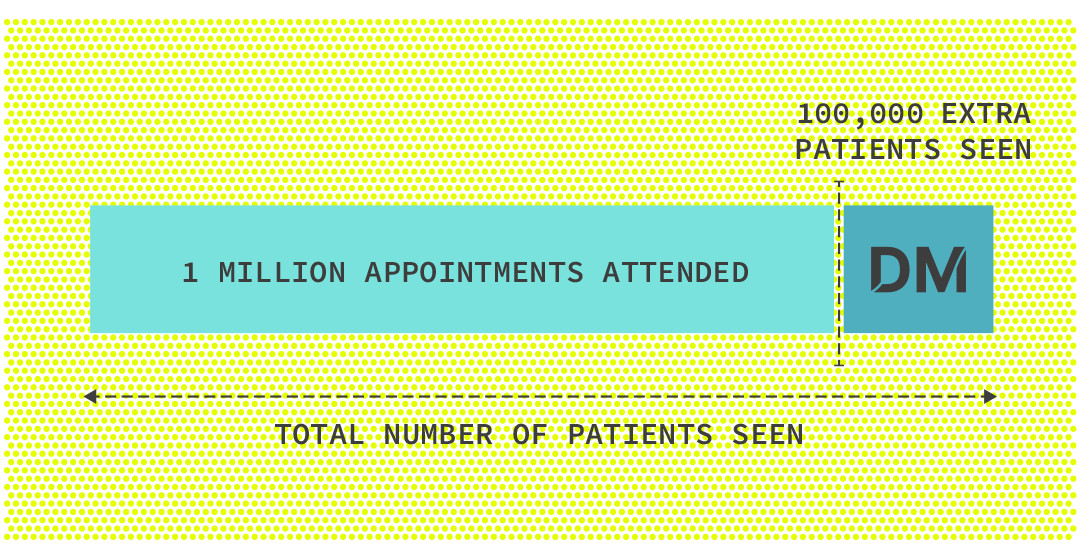
The trusts and health systems we work with manage 2.5 million outpatient appointments a year. The system is live and scaling. It is designed to recover 10% additional capacity from the resources they already have.
What recovering unused capacity actually delivers
Capacity
70,000 appointments recovered in a year at one trust.
Finance
£11.5 million of unused clinic capacity identified using refiller, backup booking and reduced DNA.
Administrative time
Refilling a cancelled appointment manually takes 32 minutes. With Deep Medical directly integrated into your administration system it is almost instantaneous.
Waiting times
Patients brought forward waited 28% less time on average. 16% of the group came out of breach of the 18 week RTT target.
Contact us for more detailed case studies.

The people it lands on
OPERATIONAL & ADMINISTRATIVE
“That definitely saves us time trying to find patients to bring forward.”
Administrator, Ashford and St Peter's Hospitals NHS Foundation Trust
CLINICAL
“I’m paid to see 12 patients and now
I see 12 patients.”
Prof Tony Young, Consultant Urologist, National Clinical Lead for Innovation, NHS England
“Deep Medical's technology will support our teams to use our appointments more effectively by identifying patients who are available at short notice to fill these slots.”
Kevin Percival, Chief Nursing Information Officer, Ashford and St Peter's Hospitals NHS Foundation Trust
PATIENT
“I hope this access to earlier appointments scheme will be available for all hospital and GP appointments, as it is useful to me and makes the best use of the doctors’ time.”
The patients who miss most are the ones who need care most
In 2019 researchers linked the general practice records of 824,374 patients in Scotland to national death records and found that people who repeatedly missed appointments were at significantly greater risk of dying early, with the risk rising as the number of missed appointments rose.
Those patients missing appointments are the people our health service is failing to reach. The same researchers then followed those patients into hospital care. Those who missed the most GP appointments were also more likely to miss hospital appointments, and they were attending two and a half times as many appointments as everyone else while doing it.

The reasons patients miss appointments are complex, individual, and often pull against each other. A 2024 study at a London NHS trust interviewed patients who had missed a first outpatient appointment, drawn from the groups the trust had identified as facing the greatest barriers to access. Nearly a third of them did not know they had an appointment at all. Letters went to shared postboxes. Reminder texts came from numbers patients could not ring back. Appointment information arrived only in English, even where the record showed another language spoken at home. Some patients were marked as absent from appointments the hospital itself had moved. Across that trust, missed appointments were not evenly spread: some groups of patients were up to 50 percent more likely to miss one than others. Wanting to attend and being able to attend are not always the same thing.

A systematic review the same year, across five countries, found no single barrier dominating. The cost of attending, transport and distance, language, and the patient's own physical and mental health all recur, and which one binds depends entirely on the person. That is why blanket reminders reach some patients and miss others.
Behind every missed appointment there is a story. The capacity was there and the patient wanted it. This is why we say these appointments go unused. What failed was what was in between. Reaching each patient in the way that works for them – and where that does not work, having another patient ready to make use of the slot - is how those appointments get used.
We want our solution to help reduce health inequality by engaging personally with patients, cutting waiting lists and helping more patients get the care they deserve.
Better for patients. Better for hospitals. Fairer for society.
References
McQueenie R, Ellis DA, McConnachie A, Wilson P, Williamson AE. Morbidity, mortality and missed appointments in healthcare: a national retrospective data linkage study. BMC Medicine 2019; 17(1): 2. doi:10.1186/s12916-018-1234-0
Williamson AE, McQueenie R, Ellis DA, McConnachie A, Wilson P. 'Missingness' in health care: associations between hospital utilization and missed appointments in general practice. A retrospective cohort study. PLOS ONE 2021; 16(6): e0253163. doi:10.1371/journal.pone.0253163
Sung B, O'Driscoll F, Gregory A, Grailey K, Franklin H, Poon S, et al. Identifying barriers to outpatient appointment attendance in patient groups at risk of inequity: a mixed methods study in a London NHS trust. BMC Health Services Research 2024; 24: 554. doi:10.1186/s12913-024-10947-8
Aldadi A, Robb KA, Williamson AE. Factors influencing multiple non-utilised healthcare appointments from patients' and healthcare providers' perspectives: a qualitative systematic review of the global literature. BJGP Open 2024; 8(4): BJGPO.2024.0075. doi:10.3399/BJGPO.2024.0075